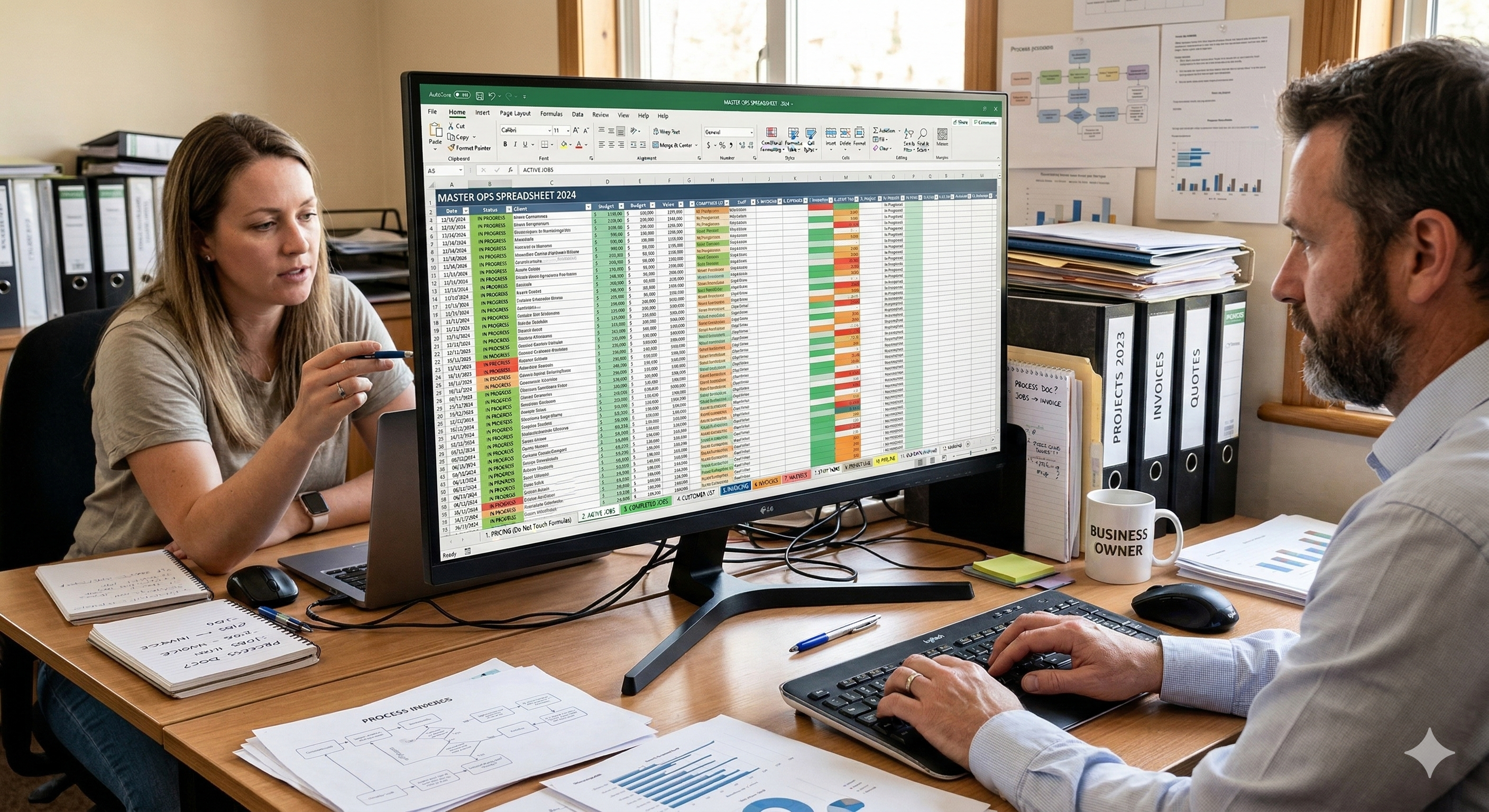
A lot of growing businesses run on a single spreadsheet. Not a tidy one — a sprawling one, with ten or twelve tabs, each serving a different purpose. Pricing on one tab. Active jobs on another. Completed jobs somewhere after that. Invoicing. Customer list. Maybe a tab called “Old stuff” that nobody opens anymore but nobody deletes either.
This isn’t a failure. It’s a phase. It’s what happens when a business grows faster than its processes, and the spreadsheet is the only tool flexible enough to keep up.
The question isn’t whether to replace the spreadsheet. The question is how to mature past it without making a mess of things in the process.
The business at this stage usually has one or two people who understand how everything connects. They know which tab feeds which. They know which cells not to touch. They know that the pricing tab has a formula for materials markup that hasn’t been updated since last year but “still works if you’re careful”. They’re carrying a lot of operational knowledge in their heads, and the spreadsheet is an extension of that knowledge rather than a replacement for it.
That’s the first thing worth recognising. The spreadsheet isn’t the problem. The concentration of knowledge is the problem. Until that knowledge is written down somewhere, the business can’t really delegate, can’t really train anyone new, and can’t really identify where things are going wrong before they go wrong.
So the first step isn’t to buy a system. It’s to document what’s already happening.
This doesn’t mean a formal process map or a flow chart with swim lanes. It means writing down, in plain language, how a job moves through the business. Where does it start? Who does what? When does a quote become an active job, and who decides that? When does an active job get marked complete, and what triggers the invoice? What happens if a customer doesn’t pay?
Most business owners who do this for the first time find two things. First, the process is cleaner in their heads than it is in reality — there are gaps, exceptions, and informal workarounds they hadn’t consciously noticed. Second, writing it down makes delegation possible in a way it wasn’t before. You can hand someone a written process. You can’t hand them the inside of someone else’s head.
Once the process is documented, even roughly, the next move is to separate things. The single spreadsheet with twelve tabs exists because everything was being managed by the same one or two people. As the business grows and more people need access to different parts of it, that structure creates problems. Someone updating the jobs list can accidentally touch the pricing. The customer list gets out of date because nobody’s sure whose job it is to update it. The invoicing tab becomes a source of confusion rather than clarity.
Breaking things up doesn’t have to mean buying software. It can mean splitting the spreadsheet into separate files, each with a clear owner. Pricing is maintained by one person. The jobs list is updated by the person running the jobs. Invoicing is the responsibility of whoever handles the money. Each part of the process has an owner, and that owner is accountable for keeping their section accurate.
This sounds simple, and it is. But it changes something important. Instead of one person holding the whole system together, multiple people hold their own section. The business becomes less dependent on any single individual’s knowledge. And because each section is smaller and more focused, problems are easier to spot.
This is also where pain points become visible in a useful way.
When the business was all in one spreadsheet, problems were easy to absorb. Someone would fix them quietly, often the same person who built the system. When responsibilities are separated and processes are written down, the friction becomes explicit. The handover between quoting and active jobs is slow. The invoicing information is inconsistent because jobs aren’t being marked complete consistently. The customer list has duplicates because two people are adding to it without checking first.
These are the real reasons to consider a system like Sage or a CRM. Not because the business is behind, or because a competitor has moved to something shinier. Because specific, documented pain points are creating real cost — in time, in errors, in delayed invoices, in missed follow-ups.
A system adopted at this point has something to work with. It can replace a process that’s understood, rather than trying to impose structure on something that isn’t. The staff who’ll use it understand what it needs to do, because they’ve been doing it manually and they know where it breaks.
This sequence matters more than people expect. The businesses that struggle most with new systems are usually the ones that bought the system first and tried to figure out the process later. Sage doesn’t teach you how to manage your jobs. A CRM doesn’t tell you what your sales process is. They give you somewhere to put things — but only once you’ve decided what things and in what order.
The businesses that get the most out of these tools tend to be the ones that arrived at them a bit reluctantly. Not because they were persuaded by a demo, but because they’d documented their process, delegated it, watched where it creaked, and concluded that a specific system would solve a specific problem better than a spreadsheet could.
That’s a much stronger starting point.
The one-spreadsheet phase is a normal part of how businesses grow. The goal isn’t to escape it as quickly as possible. It’s to use it as a foundation: to understand the process well enough to document it, delegate it, and eventually hand it over to something more capable — with a clear sense of what you’re asking that thing to do.